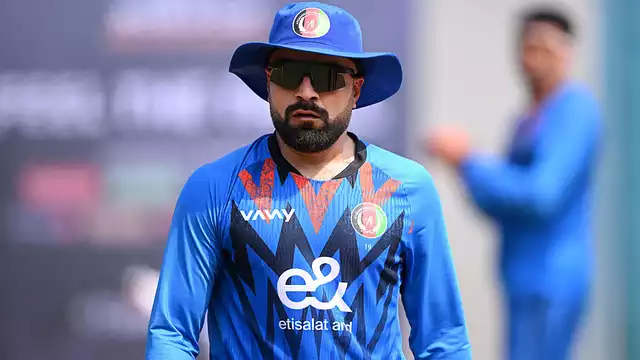
Rashid Khan Afghanistan cricket journey has been defined by resilience, pride and ambition, and the captain believes that hosting international matches in Afghanistan would mean more than winning a World Cup, as the team prepares for the ICC Men’s T20 World Cup 2026.
Rashid Khan downplays World Cup targets
Rashid Khan has visited Chennai often enough to feel at home. He still enjoys surprising locals with a few Tamil phrases. But his most memorable visit with the Afghanistan team came over two years ago, when they took a lap of honour at the MA Chidambaram Stadium after scripting history — their first-ever World Cup victory over Pakistan. The near-capacity crowd applauded a moment that signalled Afghanistan’s arrival on the big stage.
That win, at the time, was seen as a shock result. Yet Afghanistan followed it up with an even stronger statement. Despite suffering heartbreak later in the tournament — including a brutal Glenn Maxwell innings in Mumbai — they proved their rise was no accident by reaching the semifinals of the 2024 T20 World Cup. Now, heading into the 2026 global event, Afghanistan are no longer treated as underdogs. Their steady progress, backed by consistent Under-19 performances, has earned them genuine respect in men’s cricket.
With expectations rising, the obvious question follows: does Afghanistan now dream of lifting the World Cup?
For Rashid, the team’s captain, trophies are not the driving force.
“Before the 2024 World Cup, we never set targets like reaching the semifinals,” Rashid said on Saturday, a day before Afghanistan’s opener against New Zealand. “Our focus was always on playing good cricket, understanding our strengths, and finding ways to challenge strong teams.”
That approach, he insists, remains unchanged. “Even now, I don’t worry about where we finish. What matters is our energy, effort and body language. If we give everything on the field, the result will take care of itself.”
Behind Afghanistan’s growing presence lies a more complicated reality. Rashid acknowledged that the country’s cricketing structure still has significant limitations.
“We don’t play enough cricket back home, especially white-ball cricket,” he explained. “We have some four-day cricket, but limited opportunities otherwise. As a captain, it becomes difficult to select players because the pool is small.”
Comparing the situation with countries like India, Rashid pointed to the importance of competition. “When there’s competition, players push harder. For spin, the standard is already set — Rashid, Noor Ahmad, Mujeeb. Anyone coming through knows how high the bar is. We need the same level of competition in batting, and that only comes with a strong domestic structure.”
According to him, improving domestic cricket is key to long-term success. “What people see on television is mostly natural talent. We haven’t gone through enough tough domestic cricket. Once that becomes stronger, international cricket will actually become easier for us.”
Yet, for all the talk of World Cups and development, Rashid’s biggest dream lies elsewhere.
“To be honest, playing an international match in Afghanistan is bigger than winning a World Cup,” he said. “For me, for the team, and for everyone back home.”
Rashid believes hosting international cricket would change how the world views the country. “People will see how Afghanistan really is — how fans welcome players and how much they love the game. We feel support everywhere we play, especially in the IPL and World Cups, but playing in your own country is a different feeling altogether.”
He hopes that one day international teams will travel to Afghanistan. “The world will see how beautiful the country is. I truly hope that day comes.”
The conversation also touched on a sensitive topic — women’s cricket in Afghanistan. Rashid chose his words carefully, avoiding controversy. “We love to see anyone represent Afghanistan on any stage,” he said. “It’s always a proud moment when someone wears the national colours.”
For Rashid Khan, progress is about more than medals. It’s about identity, opportunity, and the simple right to play the game at home — something he believes would mean more than any trophy ever could.