Bharti Fulmali didn’t realise her long wait had ended until after she landed in Vadodara. Between stepping off her flight from Mumbai and collecting her kitbag, teammates from Gujarat Giants kept stopping by to congratulate her. Confused and unaware, Fulmali hadn’t checked her phone yet — it was still on flight mode. Once she switched it on, the floodgates opened: missed calls, messages and notifications that wouldn’t stop.
Her first call was to her sister. By the time Fulmali rang home to share the news of her India recall for the February–March tour of Australia — nearly seven years after her only previous international appearance — her family already knew. The news had travelled faster than she had. Somehow, in all the celebration, Fulmali herself had been the last to find out that the wait was finally over.
When she made her international debut in March 2019, women’s cricket in India looked very different. Domestic matches weren’t televised, the talent pool was smaller, and missed opportunities often stayed missed. After a standout domestic season, Fulmali earned her maiden cap — and just as quickly, two matches later, she was dropped.
“I felt I didn’t get many chances,” Fulmali says, reflecting calmly rather than bitterly. “Everything happened very fast — a good domestic season, an India call-up, two games, and then I was out. That phase after the drop was really tough.”
The gap between domestic and international cricket before the WPL era was stark, and Fulmali felt it deeply. She waited for a recall that never came. Then COVID struck, bringing uncertainty and silence. With no international cricket for women for over a year, doubts crept in. Walking away from the game became a recurring thought.
“Once you’re dropped from the Indian team, a comeback is very hard,” she admits. “That thought kept coming back during the COVID year.”
What kept her going was her family’s unwavering support. When Fulmali worried about finances and brought it up at home, her father reassured her. “Tu bindaas khel, hum sambhaal lenge,” he told her — play freely, we’ll handle the rest.
Still, financial security remained a pressing concern. She explored joining Railways but missed out. Determined not to give up, she continued applying for jobs through sports quotas whenever possible. At one point, finding employment became as urgent as cricket itself, with her father nearing retirement.
In 2023, she finally found stability, joining the Income Tax Department in Bengaluru — becoming the first woman cricketer in India to do so. The job brought independence and allowed her to continue playing, taking leave for camps and tournaments.
By then, the idea of an India comeback felt distant. Instead, Fulmali focused on what she could control: contributing meaningfully to her domestic team and winning trophies. While playing for Vidarbha, she made a quiet but bold decision that would redefine her career.
Rather than fighting for a crowded top-order spot, she asked herself where she could truly add value. India’s top order was stacked. The lower order, especially in T20s, needed finishers.
“That’s when I asked myself — which role is actually available?” she says. “Middle order? Finisher? And what can I realistically offer?”
Reinvention followed.
The decision wasn’t universally welcomed. Coaches questioned it. Family members wondered why she was “dropping herself” down the order. Batting lower meant fewer balls, fewer runs and fewer highlights. But Fulmali wasn’t chasing optics.
“My job wasn’t to score big runs every match,” she explains. “It was to create impact. If the team won because of a small knock at the right moment, that was enough to get noticed.”
Given a chance by then state coach Anju Jain, Fulmali embraced the finisher’s responsibility. Her mindset changed completely. If she wanted to play on big stages — for India or in the WPL — she had to handle pressure situations.
That ambition demanded more than intent. Along with her coach Sandeep Gawande, she rebuilt her batting specifically for the finisher’s role. Training became targeted and intense. Open nets replaced closed ones. Tennis balls were used to sharpen power-hitting. Brutal targets were set — most deliveries had to clear the boundary.
“If I was getting only 10 or 15 balls, I needed to know exactly where my shots were going,” Fulmali says.
Her shot range expanded too — sweeps, slog-sweeps, inside-outs — exploring areas often underused in women’s cricket. Clearing straight boundaries alone wasn’t enough anymore.
Despite the hard work, rewards didn’t come immediately. Fulmali went unsold at successive WPL auctions in 2023 and 2024.
“It was disappointing,” she admits. “The runs and strike-rate were there, but still no call.”
Then came the turning point. Gujarat Giants needed an injury replacement for Harleen Deol midway through the season. Within 24 hours, Fulmali packed, travelled, trained — and walked straight into the playing XI.
There was no time to overthink. In her first game, she scored a brisk 21 off 13 balls. In the Giants’ final match, she top-scored with 42. Even in defeat, her impact stood out. The franchise retained her.
Off-season conversations with coaches Michael Klinger and Dan Marsh helped fine-tune her game further, focusing on strike rates against pace and fielding. Though she didn’t start every match in the next WPL season, the Giants’ trust never wavered.
By the 2026 auction, Fulmali hoped for a return “home”. Mumbai Indians and UP Warriorz showed interest, but Gujarat Giants matched bids up to INR 70 lakh to keep her.
“The comfort mattered,” she says. “They understood my role, trusted me, and knew what I brought.”
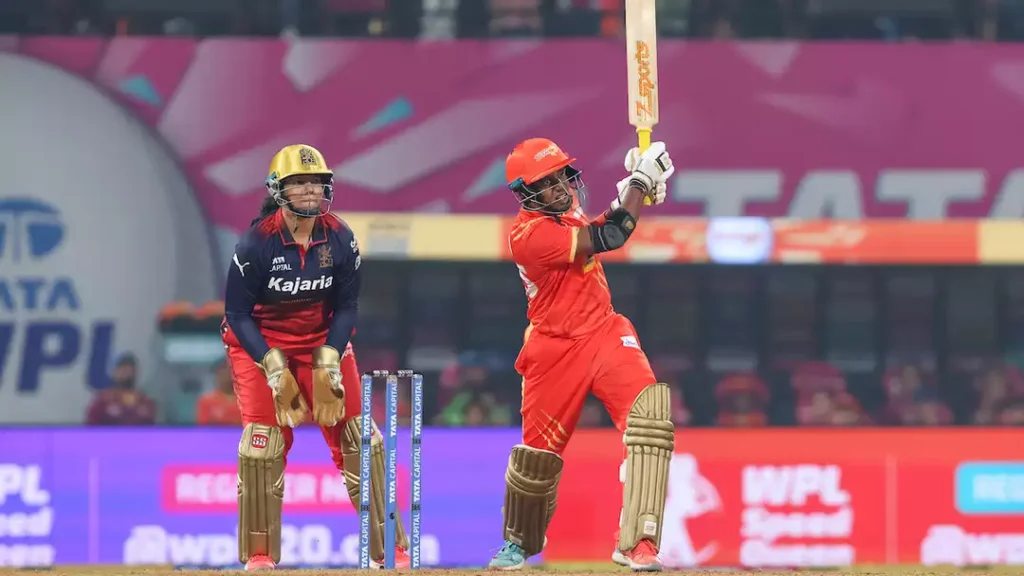
She repaid that trust immediately — explosive cameos, quickfire runs, and match-changing finishes. The sixes drew attention everywhere, including from national selectors.
And then, after more than 2,500 days away, the India recall finally arrived.
A dream that once felt distant had found its way back — through patience, reinvention, and belief.