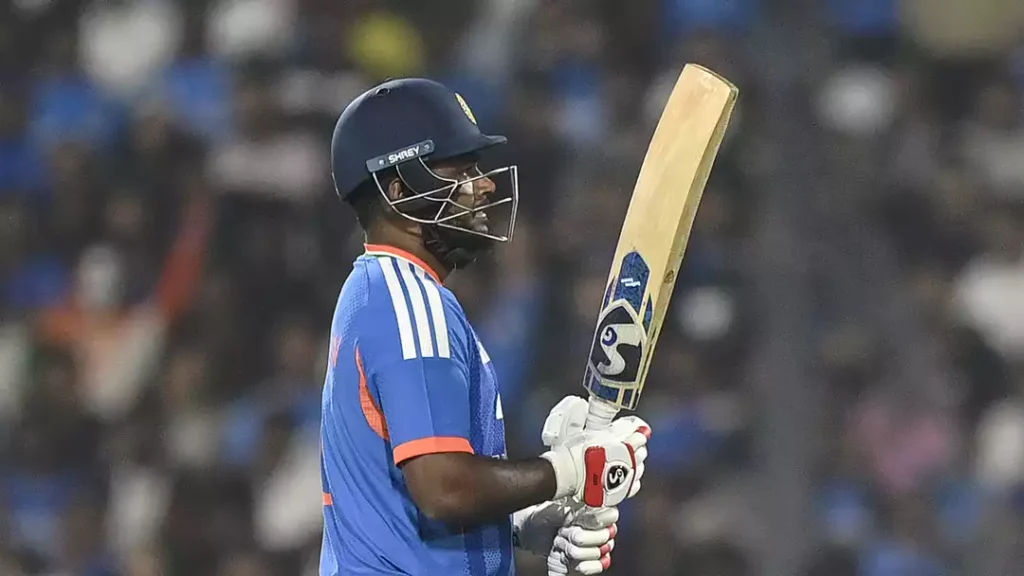
When India’s selectors finalised the T20 World Cup squad, Sanju Samson emerged as the solution to a key selection puzzle: who should partner Abhishek Sharma at the top of the order — Samson or Shubman Gill? With team balance and the wicketkeeper’s role also in play, Samson ultimately got the nod. Chief selector Ajit Agarkar later clarified that Gill’s exclusion was more about team combinations than individual form.
In many ways, this decision marked a reversal of a call made before the 2025 Asia Cup. The Abhishek-Samson opening combination had been backed through multiple series in 2024 and early 2025. However, Samson lost his place at the top when Gill returned to the XI following his Test commitments for the Asia Cup.
Pushed into the middle order, Samson struggled to find his rhythm and looked less suited to the role compared to reserve wicketkeeper Jitesh Sharma, who offered stronger finishing skills. As World Cup discussions gathered momentum, the narrative shifted again. Gill’s dip in form reopened the door for Samson as opener, while Ishan Kishan, fresh from a prolific Syed Mushtaq Ali Trophy campaign, was added as the reserve wicketkeeper and top-order cover. For the moment, everything seemed to fall into place.
However, just days before India’s World Cup opener, a concern has crept into an otherwise settled-looking T20 batting unit. India sealed a five-match series 3-0 with dominant batting displays, but Samson had minimal impact in the three completed games. In Guwahati, his innings ended instantly as he was bowled first ball while attempting a backfoot flick after moving deep in the crease.
Former India batter Ajinkya Rahane, speaking on Cricbuzz Live, pointed out a possible technical issue. He noted that Samson has been retreating too far in his crease, staying upright instead of leaning into the ball. Rahane highlighted that recent dismissals towards square leg and mid-on stemmed from this back-and-across movement, adding that while technique isn’t over-analysed in T20 cricket, small adjustments could make a difference.
The slump, however, goes beyond a single series. Since January 2025, Samson has crossed the PowerPlay just once in nine T20I innings as an opener, averaging a modest 11.55 during this period. His earlier exploits — including explosive centuries against Bangladesh in Hyderabad and South Africa in Johannesburg in 2024 — were central to India backing him over Gill. The pressing question now is how long past performances can continue to outweigh current returns.
Adding another layer to the situation is Ishan Kishan, whose aggressive approach mirrors Abhishek Sharma’s intent at the top. Kishan stunned Suryakumar Yadav with his fearless strokeplay in Raipur and complemented Abhishek perfectly during the PowerPlay blitz in Guwahati. Although his opportunities in the series came following Tilak Varma’s injury, Kishan’s experience as an opener has strengthened his case. Samson’s early exits have effectively pushed Kishan into the opening role, with entry points coming within the first two overs in each game.
With Tilak Varma set to return from the fourth T20I on January 28, India’s top-order equation grows even more complex. As the world’s third-ranked T20I batter, Tilak is expected to slot straight back into the No.3 position. That leaves India with an out-of-form opener and a confident backup knocking on the door.
Despite the growing chatter, Samson is unlikely to be under immediate threat. The team management has only recently reaffirmed its faith in him as an opener. In a series where Suryakumar Yadav rediscovered form almost overnight, Samson will be given the chance to do the same in Vizag and Trivandrum. But if the runs continue to dry up, India may once again face a major selection call at the World Cup — with Sanju Samson right at the centre of the debate.