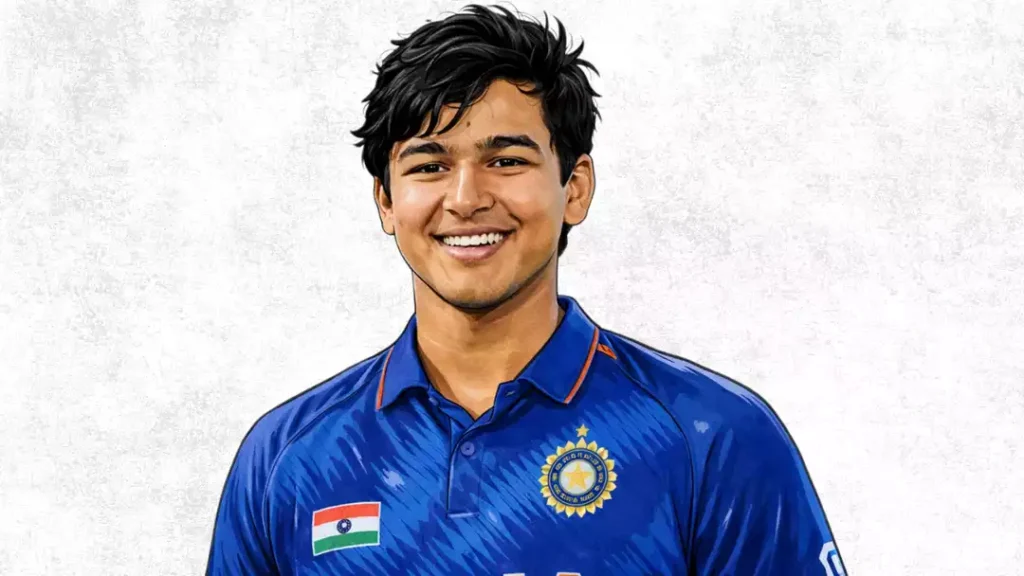
Every time registrations opened for the Sukhdeo Narain Inter-School Tournament in Patna, a familiar sight played out on the highways of Bihar. A man cycling close to 90 kilometres from Samastipur just to pick up an entry form. It wasn’t unheard of in Indian cricket, but in a state where dreams often run faster than resources, those repeated journeys left an imprint.
Manish Ojha, former Ranji cricketer and now a coach, knew fragments of that story—until the man eventually showed up at his academy. He wasn’t there for himself. That chapter had closed. He had come seeking a future for his eight-year-old son, Vaibhav Suryavanshi.
By then, Sanjeev Suryavanshi’s sacrifices were already quietly legendary. Loans had been taken, farmland sold, all to keep his son’s cricket alive. What few noticed was the discipline behind it all. Days that began before sunrise. Regular trips from Samastipur to Patna with his wife and young son—first by bus, later by car—often carrying other boys along so there would be enough bowlers at the nets. Food packed not just for Vaibhav, but for everyone who travelled.
At Ojha’s then modest academy in Anisabad, Sanjeev would spend entire days watching silently. If one bowler tired, another took over. Vaibhav kept batting. Five hundred balls a session. Sometimes more.
This routine repeated every alternate day. On the days Patna wasn’t possible, Vaibhav practiced on the terrace back home. Sanjeev spent those mornings calling around, arranging bowlers willing to make the long journey the next day.
Ojha, entrusted with coaching a child still growing into his frame, was cautious. “He was just a kid. Bowling too fast could have hurt him,” he recalls. Early sessions involved underarm throws, gentle feeds with synthetic balls. At that age, Ojha says, spotting true potential is never straightforward.
Then came a moment that changed everything.
Six to eight months into training, Ojha decided—almost out of curiosity—to use the Robo Arm. The speed was dialled up to around 130–135 kmph. Until then, Vaibhav had mostly faced predictable deliveries. This was different. “Suddenly, he adjusted,” Ojha says. “It surprised me.”
More moments followed.
At the larger academy ground in Sampatchak, Vaibhav batted alongside a state Under-19 player on a worn surface. The older player struggled. Vaibhav didn’t. “He wasn’t beaten even once,” Ojha remembers.
Soon after, Ojha asked Vaibhav to skip a practice session and play a match instead. The opposition featured bowlers with Under-19 and Under-23 experience. Vaibhav hadn’t even played district cricket yet. He scored 118, clearing the boundary repeatedly. Ojha recalls every shot. “None of the sixes were under 80 metres.”
Sitting beside Sanjeev, Ojha turned and said simply, “Your son is ready for bigger cricket.”
Yet the rapid rise also raised concerns. In practice, Vaibhav attacked relentlessly. Ojha worried whether that freedom would translate into match temperament. He wanted Vaibhav to learn survival, to bat time, not just boundaries.
So the sessions became tougher.
Water was poured on cement wickets to make balls skid. Two fast bowlers operated with new balls. Pebbles and sand were scattered to mimic uneven turn. These weren’t comfort drills—they were designed to test patience.
Vaibhav kept hitting anyway.
Not recklessly. Controlled. Calculated.
After one session designed specifically to curb aggression, Ojha finally stopped and asked why he kept attacking. Vaibhav’s answer was simple: “Why take singles off a ball you can hit for six?”
From that point, Ojha stopped trying to rein him in.
How Vaibhav Suryavanshi’s Cricket Journey Took Shape
What struck him most wasn’t just the clarity of thought, but how rarely Vaibhav spoke. Coaching often involves constant correction, Ojha says. With Vaibhav, it didn’t. “Explain once, and that was enough.”
Vaibhav avoided fitness drills with the usual childhood excuses—“My stomach hurts”—only to recover miraculously once batting began. But on the field, there was no evasion. Instructions settled quietly and stayed.
As years passed, his bat began speaking for him. Slowly, so did he.
Ojha remained grounded about his role. “People ask me to train kids for the IPL. I tell them—I can train them for Ranji cricket. That’s my experience.”
Training with Vaibhav stayed rooted in fundamentals. Cuts, pulls, uppercuts. Footwork. Head position. More footwork. Turning raw basics into a complete language of batting.
Milestones followed quickly. A century on debut in a youth Test against Australia. An IPL contract at fourteen. A first-ball six. Then 101 off 38 balls against Gujarat Titans.
After that IPL hundred, someone asked who he would call first.
“Papa,” Vaibhav said, as if there was no other answer.
When the call connected, his voice softened. “Papa, parnaam.”
Not pranam, but parnaam—the way it’s said in Bihar, sounds reshaped by home.
In that small word lived his father, his roots, and the countless journeys that once carried him—again and again—towards Patna.