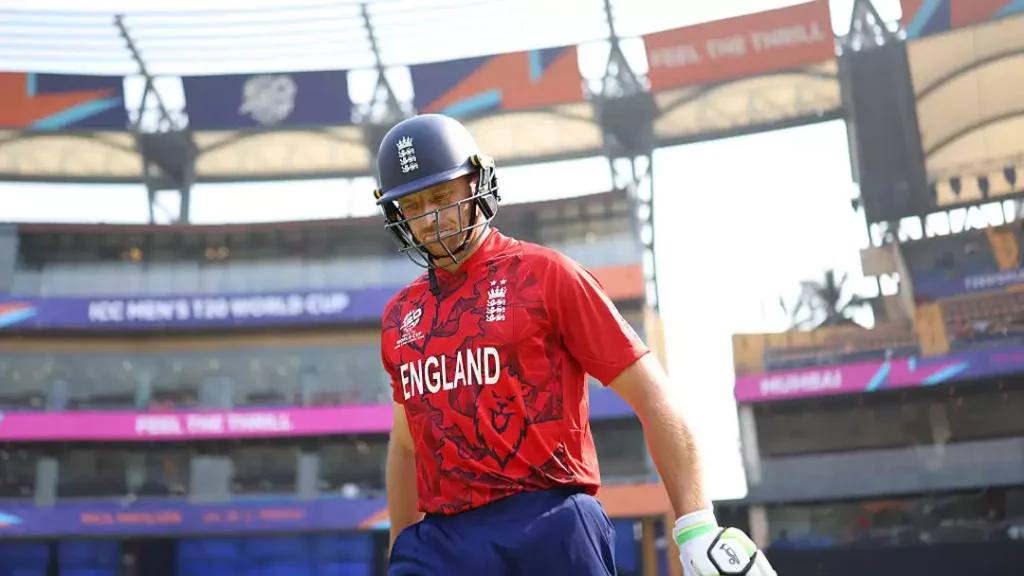
Jos Buttler T20 World Cup comments highlight why teams are prioritising percentage play over high-risk batting.
Before the T20 World Cup got underway, expectations were sky-high. Talk of 300-run totals dominated pre-tournament chatter, fuelled by predictions from Harry Brook, who pointed to flat pitches, quick outfields and short boundaries as ingredients for run-fests.
Jos Buttler T20 World Cup View on Risk and Reward
Eleven matches into the tournament, reality has painted a very different picture. Scores have stayed largely in check, with only two totals crossing the 200 mark and just one exceeding 210. The much-hyped batting explosion has yet to arrive.
Even the Wankhede Stadium in Mumbai — traditionally a paradise for batters — has defied expectations. Despite hosting power-packed line-ups like India and England, neither of the two matches at the venue so far has produced a 200-plus total. It has raised questions: were the forecasts off the mark, or have conditions been subtly tuned to ensure more competitive contests, especially between Full and Associate Member teams?
One explanation lies in the nature of tournament cricket itself. According to Jos Buttler, teams tend to approach World Cups with greater caution than bilateral series or franchise leagues.
“In World Cups, you often see teams playing the percentages more,” Buttler explained. “There’s usually less risk-taking compared to other formats.”
England next face West Indies at the Wankhede in one of the marquee group-stage fixtures between two Full Member sides. Regardless of the final score, the contest promises excitement. When the two teams last met at the same venue during the 2016 T20 World Cup, Chris Gayle produced one of the most iconic innings in the format, hammering 11 sixes on his way to an unbeaten century.
A decade on, both sides still boast an array of destructive hitters. While Gayle was a once-in-a-generation phenomenon, the modern versions of England and West Indies are no less dangerous, even if raw aggression has been tempered by situational awareness. Both teams, two-time world champions, have begun their campaigns with victories.
Buttler underlined that in tournament cricket, context matters more than milestones. “You only need one more run than the opposition on that surface on that day,” he said. “That’s the key thing in World Cups.”
West Indies head coach Daren Sammy echoed that sentiment, making it clear that his team is not chasing arbitrary numbers. “We don’t plan to score 300,” Sammy said. “We assess the conditions and try to get 20 runs above par. If par is 190, you push for 210 or 220 to give your bowlers some cushion. It’s about reading the pitch, not chasing headlines.”
Despite the measured approaches so far, the possibility of a batting explosion remains. With firepower on both sides and venues like the Wankhede still to fully reveal their character, the tournament’s first truly massive total may yet be around the corner.