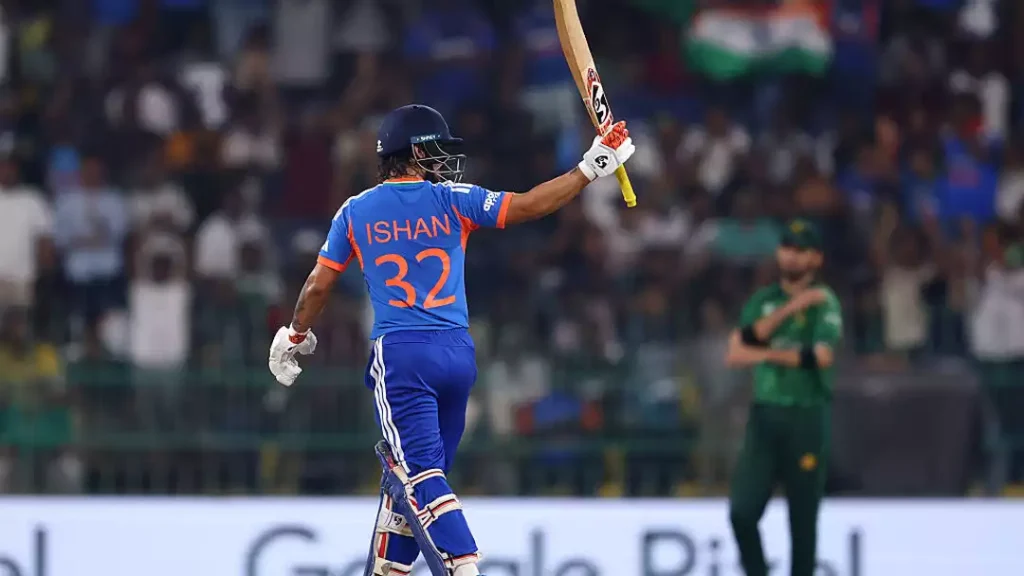
The Ishan Kishan innings proved decisive in the India vs Pakistan T20 World Cup 2026 clash in Colombo, giving India early momentum on a difficult batting surface.
On a night when experts believed 150 would be a winning total at Colombo’s Premadasa Stadium, India comfortably surpassed that mark and finished well above what conditions seemed to permit. In fact, even 120 might have proven competitive — reminiscent of the New York encounter a few years ago when India defended 119 against Pakistan.
Although the surfaces in Colombo and New York differed in character, both demanded disciplined batting. The key difference this time, however, was Ishan Kishan.
Pakistan head coach Mike Hesson admitted as much, noting that Kishan’s innings effectively put the match beyond reach. He estimated India finished roughly 25 runs above par, though the actual gap felt far larger. India weren’t just ahead — they were in complete control.
A Head Start That Changed Everything
If one factor separated this contest from previous low-scoring duels, it was the explosive start Kishan provided.
In conditions where most batters struggled to score faster than a run a ball, Kishan played on an entirely different wavelength. His 77 from just 40 deliveries came at a staggering strike rate of 192.50 — a rate unmatched by anyone else in the game.
To underline his dominance, the next-best score was Suryakumar Yadav’s 32 off 29 balls — modest by comparison for a player whose career T20I strike rate exceeds 160.
Defying Conditions and Context
The pitch appeared more difficult when India began batting than it did later in the evening. Considering the challenge, Kishan’s innings stood out not only for aggression but also for resilience.
His opening partner Abhishek Sharma, known for a similarly fearless approach, fell for a duck. The early setback, however, did nothing to slow Kishan’s tempo.
Several factors could have restrained him: the pressure of a high-stakes match, a tricky surface, a large outfield, and India’s early loss. The ground dimensions alone posed a challenge — 74 metres on one side, 84 on the other, and 72 straight down the ground — far larger than many venues in India.
None of it mattered. Kishan attacked bowlers, challenged fielders, and cleared the ropes with authority.
The Crucial Partnership
Tilak Varma, who made 24 off 25 balls, partnered Kishan in a second-wicket stand worth 87 runs in eight overs. While Tilak struggled to accelerate, Kishan dismantled Pakistan’s attack at the other end.
Even the longest boundary seemed insufficient to contain his power. Fielders stationed on the rope were no deterrent; Kishan continued to attack aerially with confidence.
A Simple but Effective Method
Despite the ferocity of his strokeplay, Kishan’s approach remained uncomplicated.
His wide, flowing backlift and wristy follow-through allow him to generate natural power, particularly on the leg side. Yet he used the off side effectively to force bowlers to alter their lines.
With the ball gripping and turning, he repeatedly created room outside off stump, tempting bowlers to attack his pads — only to whip them away into the leg side.
Hesson later highlighted Kishan’s versatility, noting his ability to score all around the ground and even reverse against spin, which prevented Pakistan’s bowlers from settling into consistent plans.
Momentum and Its Aftermath
After India slipped to 1 for 1, they surged to 88 for 1 by the ninth over. With Kishan in control, the scoring rate hovered near ten an over and a 200-plus total seemed realistic.
Once he departed, however, the momentum dipped. Over the next eight overs, India’s scoring slowed dramatically, before a late surge lifted the total beyond reach.
Captain Suryakumar Yadav praised Kishan for taking responsibility after the early wicket, crediting his PowerPlay assault for putting India firmly ahead.
Kishan himself reflected on keeping things simple — watching the ball, backing his strengths, and using the field intelligently.
A Comeback Story
Kishan’s return to prominence adds an emotional layer to the performance.
Once a regular in India’s setup — and the scorer of a double century in ODIs — he spent over two years away from the national side after withdrawing from a tour and missing domestic fixtures. Asked to return to domestic cricket, he went back to Jharkhand, led the team in the Syed Mushtaq Ali Trophy, and scored 517 runs in the tournament.
That resurgence paved the way for his return.
And on this night in Colombo, his fearless assault did more than boost India’s total — it defined the match.