The India vs Namibia T20 World Cup 2026 clash in New Delhi saw Namibia stand tall under intense pressure before India’s superior firepower proved decisive. Despite moments of resistance with both bat and ball, Namibia were undone by small margins in a high-paced contest.
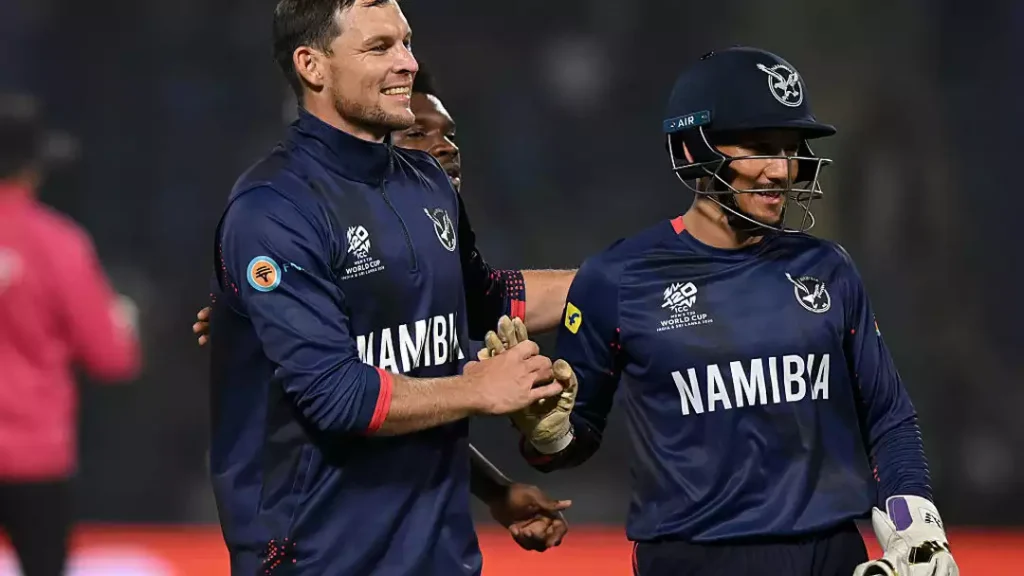
Ben Shikongo followed the ball with a look that mixed frustration and disbelief. As he crossed paths with Hardik Pandya, the Indian all-rounder offered a quick pat on the back — a small gesture that summed up the night.
The Namibian pacer had almost delivered a flawless over. His wide yorkers denied Pandya the room he usually thrives on. Against Shivam Dube too, he forced the batters to reach, cutting off angles and big-hitting arcs. For most of that 16th over, Shikongo looked in complete control.
But T20 cricket rarely forgives even the slightest error.
One missed yorker disappeared straight over long-on. The next full ball was carved away for four. A near-perfect over ended with 16 runs. In a format where India have prided themselves on scoring over ten an over at the death throughout this World Cup cycle, such small slips are magnified.
That final boundary — and Pandya’s reassuring pat — captured the gap between effort and outcome.
Early Resistance Against India’s Firepower
For stretches of the game, Namibia competed as if the gulf between Associate status and India’s heavyweight reputation did not exist.
They began smartly against Ishan Kishan, targeting him with deliveries angled wide outside off — an area he has worked to expand but still carries occasional vulnerability. The USA had recently exposed that zone, and Namibia followed suit.
Soon after, they altered their plan. Deep fielders shifted leg-side, and straighter lines were employed in search of a mistimed stroke.
But against a batter in commanding touch, those plans unraveled quickly. India stormed to 86/1 in the PowerPlay. Within five more deliveries, they had registered the fastest team hundred in T20 World Cup history.
India’s dominance in the PowerPlay over the last two years has been relentless. Few sides have managed to withstand that assault without unraveling completely.
Namibia refused to collapse.
Spin Pushback in the Middle Overs
Gerhard Erasmus and Bernard Scholtz applied the brakes.
Across six overs of spin in the middle phase, Namibia conceded just 30 runs and picked up three crucial wickets. Tilak Varma, who has struggled against spin since early 2025, found the going tough again. His strike rate against middle-overs spin has dipped noticeably, and here he managed only five runs off ten balls before misjudging an Erasmus delivery released from deep behind the crease — one of the captain’s signature variations.
For a brief period, Namibia shifted the momentum.
India were checked. The crowd quietened. The contest felt balanced.
A Final-Over Fight
Even at the death, where India often bury teams under a cascade of boundaries, Namibia showed resilience.
Ruben Trumpelmann and JJ Smit delivered disciplined wide yorkers to deny Rinku Singh and Shivam Dube easy leverage. Erasmus chipped in with a sharp over that included two wickets and a run-out.
India, usually explosive in the closing overs, managed only 25 runs from the final 18 balls. They finished with 209/9 — imposing, but not insurmountable by modern T20 standards.
Namibia had limited the damage. That alone was an achievement.
Varun’s Spell Breaks the Chase
The chase began with purpose.
Namibia matched India stride for stride during the PowerPlay and even negotiated an over from Jasprit Bumrah without major damage. There was belief.
Then came Varun Chakaravarthy.
Armed with mystery and subtle variations, he delivered a spell Namibia simply do not encounter in Associate cricket. Starting with a googly, mixing pace and trajectory, he unsettled the batters immediately.
By the end of his second over, the contest had tilted decisively.
Erasmus later admitted the challenge.
“That kind of mystery spin is something we don’t naturally face,” he said. “You see leg spin occasionally, but consistent googlies and doosras are rare at our level. There are very few bowlers in Associate cricket who operate like that.”
He acknowledged the lesson.
“You can watch footage, study data, plan your approach — but facing it in real time is different. That was the turning point.”
Varun’s early burst effectively sealed the outcome.
Competing Under the Spotlight
Before the match, Erasmus had worried that the occasion might overwhelm his team — a World Cup night game in India, against India, in front of a roaring crowd.
Instead, Namibia met the moment head-on.
They adapted, counter-punched, and fought through phases where lesser sides have wilted. They did not shrink under the glare.
But the scoreboard told a harsher truth.
In elite T20 cricket, being competitive is not the same as being enough. Namibia were disciplined, courageous and tactically sharp at times. They earned that pat on the back.
Yet against a team operating at the cutting edge of modern T20 intensity, small margins become decisive gaps.
Namibia stared into the bright lights without blinking.
They just couldn’t stop the inevitable shine.