India Identity Crisis
India’s identity crisis has become a serious concern after their heavy defeat against South Africa at the Narendra Modi Stadium in Ahmedabad. The loss exposed deeper problems in India’s batting approach and raised questions about whether the team can adapt under pressure.
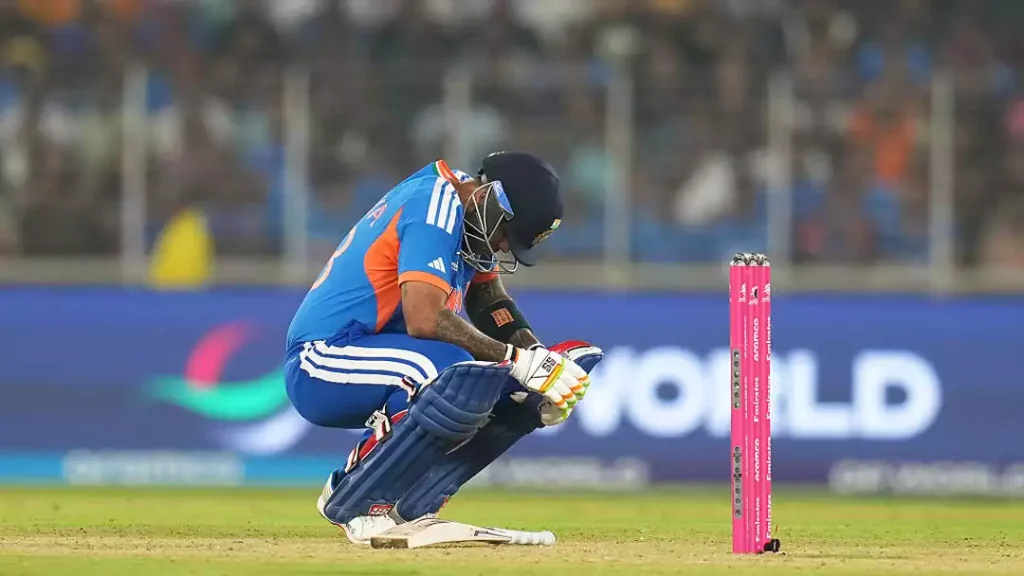
For Suryakumar Yadav, the disappointment was painfully familiar. Nearly two and a half years ago, he experienced heartbreak at the same venue. This time he was leading the side, and although the match was not a World Cup final, the impact of the defeat was significant.
After the match, Suryakumar said:
“If you are chasing 180–185, you cannot win the game in the Powerplay, but you can lose it.”
This statement reflects a shift in India’s mindset.
Powerplay Strategy Under Question
Just weeks ago, India entered the tournament as the most feared batting unit. Their aggressive starts defined their dominance throughout the 2024–2026 World Cup cycle.
India have scored nearly 10 runs per over in the Powerplay, one of the highest rates among top teams.
Run Rates in This World Cup Cycle
| Team | Powerplay | Middle Overs | Death Overs |
|---|---|---|---|
| India | 9.87 | 9.59 | 10.42 |
| South Africa | 7.79 | 8.91 | 9.08 |
| Zimbabwe | 8.36 | 7.82 | 9.75 |
| West Indies | 7.91 | 8.24 | 9.91 |
India’s success has been built on explosive starts. But when early momentum disappears, their batting looks fragile and predictable.
Slow Pitches Expose India Identity Crisis
The World Cup surfaces have not suited India’s aggressive style. Sticky pitches have caused early collapses and forced the team into recovery mode.
Against the USA, India slumped to 46/4 in the Powerplay before recovering. Assistant coach Ryan ten Doeschate admitted the team needed a batting Plan B.
Although India bounced back strongly against Namibia, players admitted the pitch was difficult early on. Ishan Kishan noted the ball was holding up, while Hardik Pandya said the surfaces were not ideal for batting.
India’s batting thrives on flat pitches. When conditions slow down, their approach loses effectiveness.
One-Dimensional Batting Approach
During home series on true batting tracks, India dominated:
✔ fast starts
✔ pressure on bowlers
✔ control of middle overs
✔ explosive finishing
But when the first phase fails, the entire structure collapses.
South Africa exploited this weakness perfectly, reducing India to 31/3 in the Powerplay and never allowing recovery.
Need for Tactical Recalibration
Assistant coach Ryan ten Doeschate highlighted the core challenge:
India must learn to play on surfaces that behave differently from what they are used to.
On slow wickets:
- the ball grips
- timing becomes difficult
- lofted shots carry risk
- power hitting becomes ineffective
Adapting sounds simple but is difficult. For two years, India’s batters have built success on fearless attacking starts.
Their aggressive identity now faces its biggest test.
Can India Reinvent Their Batting Approach?
India’s top-order batters are conditioned to attack from the first ball. Recalibrating mid-tournament is extremely challenging.
Yet the situation leaves no room for debate.
With a Net Run Rate of –3.800, India’s title defence hangs in the balance.
Their fate now depends on how quickly the batting unit adapts against Zimbabwe and West Indies in the coming matches.
Conclusion
The India identity crisis is not about talent — it is about adaptability. On flat pitches, India look unstoppable. On slow surfaces, they appear vulnerable.
To stay alive in the tournament, India must evolve beyond their aggressive blueprint and develop a flexible strategy suited to varying conditions.
The next week will determine whether India remain title contenders — or a team undone by its own identity.