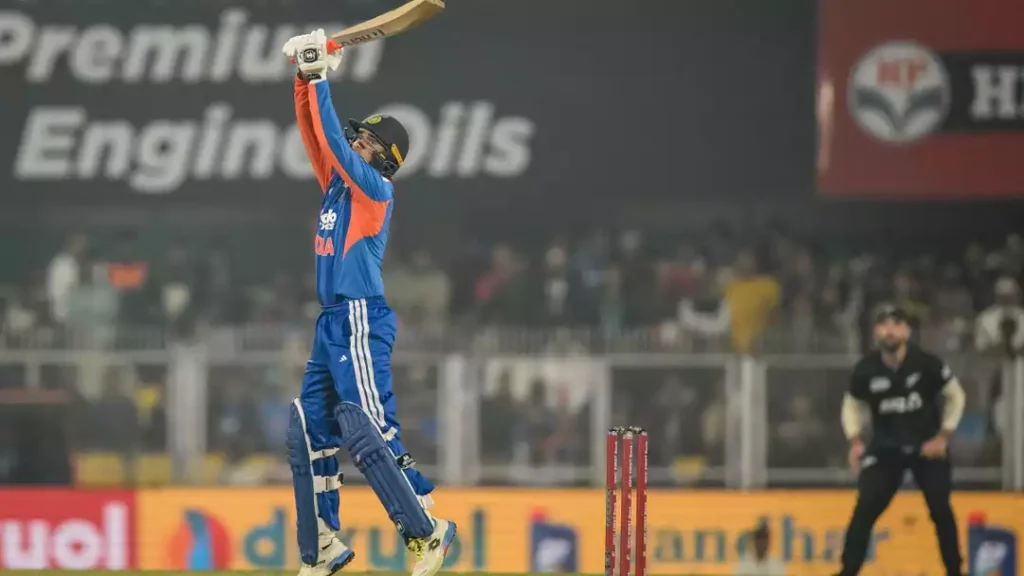
Abhishek Sharma T20 batting has emerged as a blueprint for the future of the format, combining extreme scoring rates with rare consistency and challenging long-held assumptions about risk and sustainability in modern cricket.
If modern T20 batting were a science experiment, Abhishek Sharma would look uncannily like the finished prototype.
Few observations capture the peculiarity of his rise as crisply as one from Tabraiz Shamsi. In a post last December, the former world No.1 bowler noted how Abhishek seemed to clear the ropes effortlessly against every kind of bowling, all while maintaining a relentless strike rate. “Usually,” Shamsi wrote, “batters who play like that fail far more often.”
That comment cuts to the heart of why Abhishek’s numbers feel so unsettling. T20 cricket has conditioned bowlers to believe unchecked aggression eventually corrects itself. But Abhishek thrives precisely where that expectation collapses. The surprise isn’t his intent — it’s that the collapse rarely follows.
Abhishek Sharma T20 Batting Breaks Traditional Risk-Reward Models
Modern T20 cricket has long accepted that relentless aggression comes at the cost of frequent failure. Abhishek Sharma’s numbers suggest that assumption may no longer hold true, as his method stretches scoring ceilings beyond conventional limits.
The data explains the disbelief. Abhishek’s T20I record reads like a glitch: a strike rate nearing 195, an average above 37, a boundary every 3.2 balls, and a six every 7.6. No one in T20I history combines strike rate and boundary frequency quite like him. Even his closest comparator, Andre Russell, edges him only marginally in balls-per-six.
These aren’t inflated numbers built on cameos or sheltered roles. They span 38 international innings — a large enough sample to move beyond novelty. Only a handful of players have scored 1000-plus T20I runs at both a 35-plus average and a 160-plus strike rate. Among Full Member nations, that group shrinks further, and Abhishek stands clear of them all on scoring speed while matching their consistency.
The closest thing to the perfect T20 batter
Abhishek’s greatest strength may be his refusal to fit into a box. He dominates both pace and spin, scores freely in every arc of the field, and neutralises traditional defensive plans. There’s no obvious length to hide on, no angle that reliably slows him down.
Plenty of batters have flirted with extraordinary peaks in T20 cricket — often briefly, often in specialised roles. Abhishek’s difference lies in how early he reached those heights, and how comfortably he’s stayed there.
Breaking the oldest T20 rule
At the core of T20 batting lies a familiar compromise: score faster and you shorten your stay; bat longer and your scoring rate dips. Plot strike rate against balls per dismissal and the relationship is almost universal.
Almost.
Abhishek sits visibly away from the trend. He accepts the traditional risk — favouring speed over survival — but stretches the ceiling of run-scoring so far that the cost of getting out becomes secondary. Risk hasn’t vanished; it’s simply been overwhelmed by reward.
Debuting in the mid-2020s, Abhishek represents where elite T20 batting is headed. Just as Virat Kohli once embodied control and volume, and Suryakumar Yadav later expanded the game through innovation, Abhishek compresses time, margin, and risk into a single, uncompromising method. With his first senior World Cup approaching, the more pertinent question may be whether the tournament adapts to him — not the other way around.
Every ball is an opportunity
Abhishek’s philosophy is brutally direct: each delivery is there to be punished. In nine of his 37 innings, his very first scoring shot was a six — five of them off the first ball he faced.
His early-innings numbers are staggering. Across his first 10 balls, he strikes at over 183 — the highest among batters with 25 or more T20I innings. Among Full Member teams, only Tim David and Shahid Afridi even approach those levels, both operating lower in the order where early wickets cost less.
What truly separates Abhishek is sustainability. His aggression doesn’t fade as the innings progresses. In fact, it intensifies — climbing past 200 after the first 10 balls and soaring even higher the longer he stays.
No obvious weakness
Even the very best batters usually carry a visible vulnerability. If Abhishek has one, it hasn’t surfaced yet.
Against spin, he strikes above 210. Against pace, close to 190. He averages more than 35 against almost every bowling type he’s faced, while striking above 170 across the board. Leg spin has dismissed him a few times, but even there, his scoring rate remains astronomical — and most dismissals come deep into innings, suggesting calculated excess rather than technical frailty.
Among batters from Full Member nations who dominate both pace and spin, only Tim David matches Abhishek statistically — and even then, Abhishek surpasses him on both strike rate and consistency.
The Powerplay disruptor
The Powerplay remains the most volatile phase of a T20 innings, and Abhishek treats it as a launchpad. His Powerplay strike rate of 192 is the highest among regular openers from Full Member teams, comfortably ahead of even Travis Head.
What makes this more striking is its portability. On slower UAE surfaces during the Asia Cup, Abhishek’s method didn’t adjust — it thrived. Unlike most Powerplay aggressors, he accelerates further once the field spreads, lifting his scoring rate beyond the first six overs.
Carrying India in the fastest era
Since January 2025, Abhishek has been India’s most influential T20 batter. Across five series, he has consistently finished among the leading run-scorers, often in challenging conditions.
In that period, he has contributed nearly a quarter of India’s total runs — the highest share by any batter from a Full Member nation with a similar sample size. Even in one of the fastest-scoring T20I teams ever assembled, Abhishek scores at a rate that leaves the rest behind by a remarkable margin.
Measured against the greatest peaks
When Abhishek’s career is stacked against the best 37-innings peaks in T20I history, the picture sharpens. While his aggregate run tally sits around the top ten, his strike rate is unmatched — more than 20 points clear of the next best at their absolute peak.
Players like Mohammad Rizwan once represented the other end of the spectrum: supreme sustainability at the cost of speed. Abhishek has spent his first two years at international level dismantling that trade-off altogether.
In doing so, he isn’t just succeeding within T20 cricket’s framework — he’s quietly rewriting it.
As T20 cricket accelerates into its next phase, Abhishek Sharma appears less like an outlier and more like a signal. His success hints at a format where speed and sustainability are no longer opposites — and where batting benchmarks are set to rise again.